

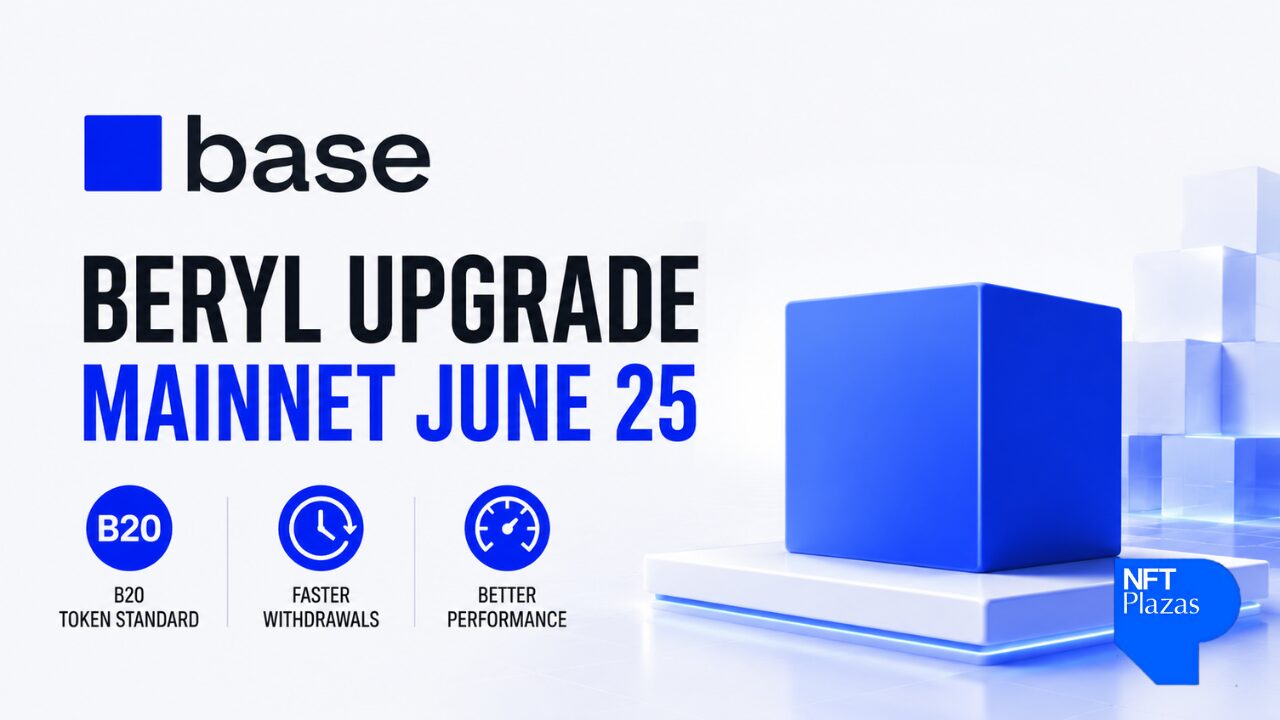

Coinbase’s Ethereum Layer 2 network Base has confirmed June 25 as the mainnet activation date for its Beryl network upgrade, its most technically significant release since launch. Beryl introduces B20, a native token standard for issuing stablecoins and other assets directly within Base’s node software, and cuts the chain’s standard withdrawal delay to Ethereum from seven days to five. The upgrade is already running on Base Sepolia testnet ahead of the mainnet deployment.
What Is Beryl?
Beryl is Base’s second independent network upgrade, following Azul, which reached mainnet in May. Its centerpiece is B20, a protocol-level token standard that lets issuers create stablecoins and other assets at the protocol level. Beryl builds directly on the foundation Azul established, extending Base’s withdrawal infrastructure and node performance in addition to introducing B20.
The upgrade carries three core components: the B20 token standard, reduced withdrawal delays, and the Reth V2 execution client update.

What Is Beryl?
B20: A Token Standard Built Into the Chain
The headline feature of Beryl is B20, and its architecture sets it apart from conventional token creation. Unlike traditional ERC-20 tokens that operate through smart contracts, B20 tokens run as precompiled contracts inside Base’s node software. Base said the token logic is written in Rust and executes directly within the protocol rather than through EVM bytecode.
B20 is an ERC-20 superset implemented as a native precompile: it keeps full ERC-20 compatibility while building roles, transfer policies, supply caps, pausing, memos, and permit directly into the chain. You create a B20 token by calling the singleton B20 factory precompile — there is no token contract to write, deploy, or audit.
That ERC-20 compatibility is a deliberate design choice. Existing wallets, exchanges, and indexers that support ERC-20 tokens can integrate B20 assets without modification. From the perspective of the broader ecosystem, a B20 token behaves identically to any other ERC-20 asset — no new integrations required.
B20 ships in two variants. At launch, B20 supports both a general-purpose asset format and a stablecoin-specific version that uses fixed six-decimal precision and allows issuers to define a currency code. The stablecoin variant is clearly aimed at regulated issuers who need currency-denominated precision baked in from day one.

B20 is Base’s native token standard
Issuer Toolkit and Compliance Controls
Alongside the standard itself, Base is shipping an Issuer Toolkit designed for institutional-grade asset management. The toolkit includes role-based access controls, minting and burning capabilities, optional supply caps, transfer restrictions, and freeze-and-seize functions. The codebase has been audited by Base and security firm Spearbit.
Additional enhancements to the B20 framework are also planned, including the ability to pay transaction fees using B20 assets and further throughput improvements. Base’s engineering team has also indicated that native execution at the protocol level could cut transfer costs by roughly 50% compared to smart-contract-based equivalents, and approximately double transfer throughput.
Faster Withdrawals to Ethereum
Beryl cuts Base’s standard withdrawal delay to Ethereum from seven to five days, building on withdrawal improvements introduced with the Azul upgrade in May.
The context matters here. Azul introduced a faster, one-day finalization path for withdrawals when both a TEE and a zero-knowledge proof agree a transaction is legitimate, but that path sees little use in practice because generating the ZK proof is costly. Beryl instead targets the slower, more commonly used single-proof path. The five-day window still provides a buffer for detecting and disabling a faulty prover before funds are released — the security rationale behind the original seven-day design.
Reth V2 and Node Performance
The third component of Beryl is the integration of Reth V2, an updated execution client. The upgrade reduces disk usage across full, minimal, and archive node configurations while improving how quickly nodes calculate state roots. Base has said the efficiency gains will allow it to raise block gas targets and limits without overloading its sequencer or node infrastructure — effectively creating headroom for future throughput expansion.
What Users and Operators Need to Do
The Beryl upgrade has already been tested successfully on the Base Sepolia testnet and is scheduled to activate automatically on mainnet on June 25. Users are not required to take any action ahead of the upgrade. However, node operators must update to the latest software version before activation to maintain network compatibility.
The Institutional Play — and the Token Question
The strategic context behind Beryl is Base’s pursuit of institutional tokenization business. Tokenized real-world assets have reached roughly $34 billion in value industry-wide, with the stablecoin market above $300 billion, and Base — through Coinbase’s positioning — has already captured a significant share of agentic stablecoin payment volume. B20 is designed to lower the cost and friction of minting compliant assets natively on Base, making the chain a direct competitor for issuer business against rival networks including Solana, which has introduced its own GENIUS Act-aligned stablecoin and RWA issuance tooling.
One clarification worth making: B20 is a standard for third-party issuers, not a native Base governance or utility token. Despite headlines framing the upgrade as a step toward a token launch, B20 does nothing to confirm one. Current prediction markets indicate a 28.5% probability for a token launch by December 31, 2026. The two questions — institutional issuance infrastructure versus a potential Base community token — remain entirely separate.
What Comes Next
Base has already outlined its next upgrade on the roadmap. With Beryl, Base is taking another step toward becoming a specialized infrastructure layer for institutional blockchain applications, reinforcing the industry’s broader shift toward tokenized finance and on-chain capital markets. Cobalt, targeted for September, is expected to introduce native account abstraction, expand B20 functionality, and unify Base’s consensus and execution clients into a single node binary — a further consolidation of the chain’s infrastructure as it builds toward large-scale, regulated issuance.