

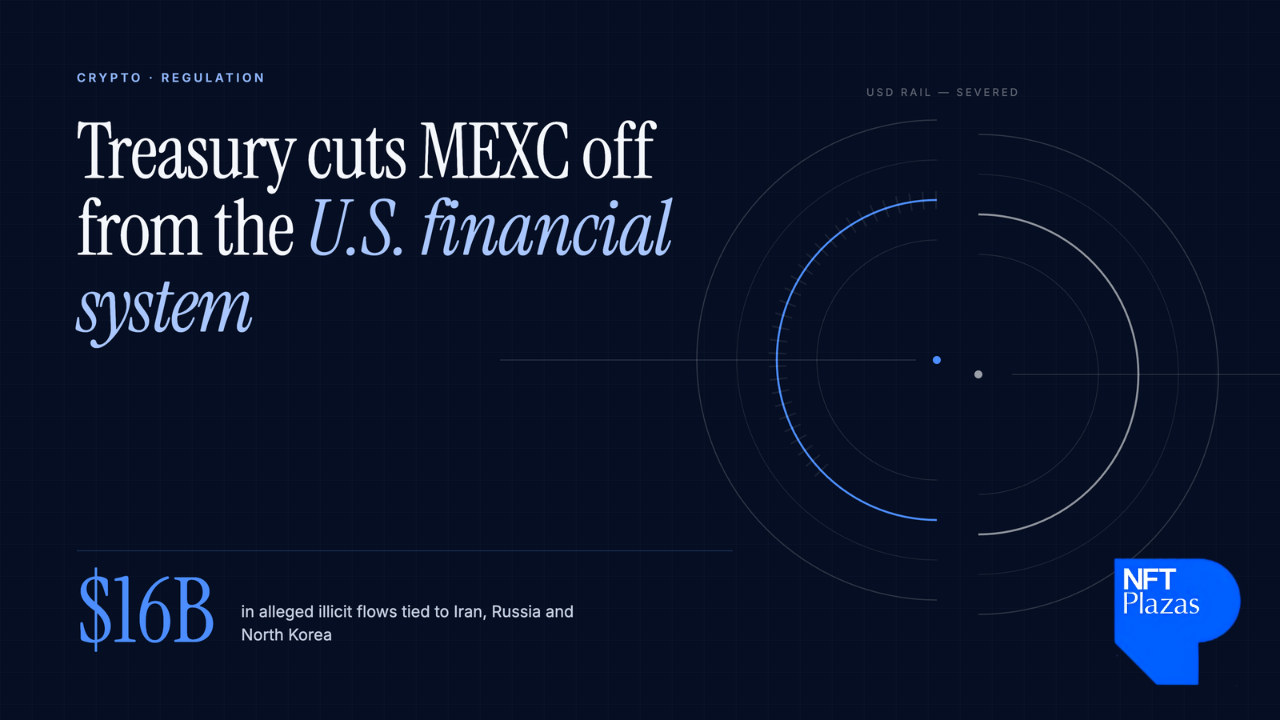

The U.S. Treasury Department has moved to shut one of the world’s largest crypto exchanges out of the American financial system. On Friday, the department’s Financial Crimes Enforcement Network (FinCEN) issued an order barring U.S. financial institutions from processing any funds transfers to or from MEXC Global. Treasury accuses the exchange of handling at least $16 billion in illicit money tied to Iran, North Korea and Russia.
The ban takes effect 30 days after the order is published in the Federal Register. After that, any U.S. institution that keeps moving money for the exchange could face civil or criminal penalties.
“Financial institutions cannot have it both ways: Either you support the Iranian regime, or you have access to the U.S. financial system,” Treasury Secretary Scott Bessent said. He added that Treasury would keep cutting off the regime’s economic lifelines and blocking its attempts to use digital assets to get around sanctions.

Treasury Cuts MEXC Off From U.S. Banks Over $16B in Illicit Flows
What FinCEN says it found
MEXC is no fringe platform. Founded in 2018, it ranks among the 20 largest crypto exchanges in the world. According to FinCEN, it processes more than $1 billion in trades a day, holds about $5 billion in reserves and lists more than 3,000 tokens. The order also notes that the exchange is registered in the Seychelles, holds no virtual asset service provider license, operates in more than 170 countries, and accounted for roughly 9% of the global centralized crypto exchange market as of December 2025.
FinCEN says at least $16 billion connected to illicit activity moved through the platform between May 2021 and May 2026. The 24-page order puts the precise figure at about $16.7 billion. The breakdown shows how widely the exposure spread:
- Nearly $1.5 billion tied to evading Russia-related sanctions, including $232 million in direct transactions with entities sanctioned by the U.S., the EU and the U.K.
- At least $26 million benefiting Russia’s A7 sanctions-evasion network
- Nearly $200 million involving A7A5, the ruble-backed stablecoin the network used
- Around $1 billion in direct dealings with more than 40 Iranian crypto exchangers
- About $22 million benefiting the Central Bank of Iran and the Islamic Revolutionary Guard Corps, including its Quds Force
The order also cites more than $13 billion in transactions with at least four high-risk exchangers sanctioned by the U.K.
The most damaging detail may involve Garantex, the Russian exchange the U.S. sanctioned in 2022. FinCEN says MEXC was still trading with Garantex and its successor, Grinex, as recently as June 2026, more than four years after the first designation. On that basis, the agency named MEXC a “primary money laundering concern” in connection with Russian illicit finance.
On paper, MEXC had anti-money-laundering rules and barred users from places like Iran and North Korea. FinCEN says that in practice, its compliance program suffered from “severe deficiencies.”
A different tool, not a standard sanction
The order does not come through the Office of Foreign Assets Control’s sanctions list. Instead, FinCEN issued it under section 9714(a) of the Combating Russian Money Laundering Act. The difference matters. The measure cuts off U.S. institutions from transfers involving MEXC, but it is not a worldwide asset freeze, and MEXC is not automatically sanctioned globally.
FinCEN has increasingly turned to this authority to target crypto platforms that sit outside the traditional correspondent banking system, where conventional sanctions often have less bite. It used the same provision against the Russian exchanger PM2BTC in 2024.
One piece of a wider campaign
The action falls under Operation Economic Outcast, a whole-of-Treasury effort launched on August 24, 2026, to sever Iran’s global financial, trade and logistics connections. MEXC’s ties to Garantex, Grinex and A7A5 place it inside a sanctions-evasion network that Treasury has been taking apart piece by piece.
Last month, Treasury designated Russia’s A7 Network a transnational criminal organization and proposed cutting its front companies off from U.S. finance. It flagged more than $179 billion in transactions through the A7A5 token, much of it routed through Garantex and Grinex. The campaign has also reached Iran’s crypto sector, where Treasury gained broad authority to sanction anyone operating in it and blacklisted the Iranian exchange Nobitex for funneling crypto to the IRGC. Alongside the MEXC order, Treasury also sanctioned eight Canadian companies it says helped Iran, Russia and North Korea evade sanctions and move funds linked to cybercrime and drug trafficking.
North Korea remains a central concern. Its hackers have stolen more than $6.7 billion in crypto since 2016, by one industry tally, including about $2 billion in 2025. In the first four months of 2026, they took $577 million, roughly 76% of all crypto losses over that period.
How MEXC and the market responded
In a public statement, MEXC said it was aware of the November 6 order and was reviewing it closely with its legal and compliance teams. The exchange said operations were normal, user assets were safe, it would engage constructively with FinCEN, and it had begun an independent review of its anti-money-laundering and sanctions controls.
Users did not wait to find out. On-chain data showed about $126 million in net outflows from MEXC in the 24 hours around the announcement. At least one token issuer moved quickly as well: NatGold Digital requested the immediate delisting of its NATG token from MEXC after the order.
What comes next
The 30-day clock has not started yet. It begins only once the order appears in the Federal Register. Even so, the practical effects may arrive sooner. Payment processors, wallet providers and other exchanges with U.S. exposure may start screening or rejecting MEXC-linked funds well before the legal deadline.
For the wider crypto industry, the message from Washington is blunt. Size and global reach will not shield an exchange that keeps doing business with sanctioned networks. If the money flows lead back to Tehran, Moscow or Pyongyang, Treasury has shown it is willing to cut off access to the dollar entirely.