

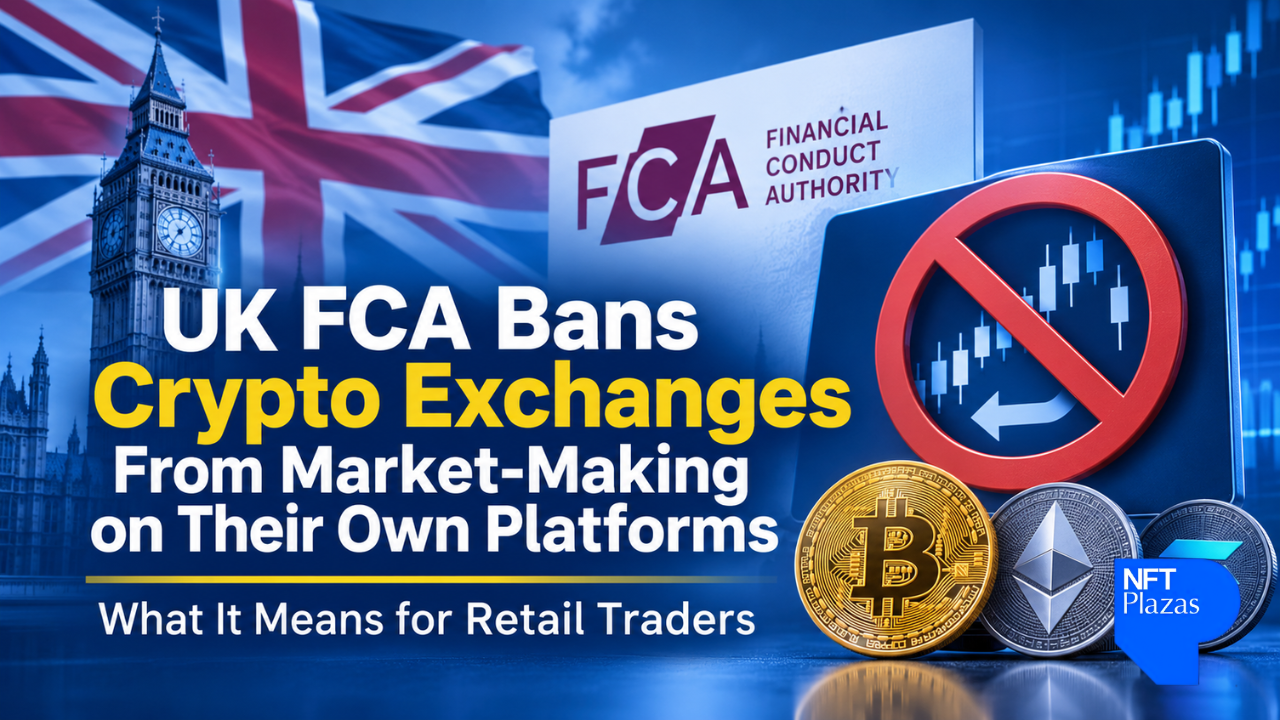

Crypto exchanges serving the UK will no longer be allowed to trade against their own customers. Under final rules from the Financial Conduct Authority (FCA), operators of cryptoasset trading platforms will be barred from acting as market makers on the venues they run, starting October 25, 2027, the day the UK’s full cryptoasset regime comes into force.
The rule closes a conflict of interest that has existed since crypto trading began. It also changes where liquidity on UK platforms will come from, and that matters for anyone who buys or sells digital assets.
What the FCA has actually banned
The FCA published the restriction on June 30, 2026, in policy statement PS26/11. That statement was one of five documents that completed the regulator’s crypto rulebook. The wording is direct: a firm “must not execute any orders against its proprietary capital” on a qualifying trading platform it operates. The FCA’s guidance says plainly that such a firm “cannot act as a market maker” on its own venue.
The rulebook defines a market maker as someone who continuously offers to buy and sell cryptoassets with their own capital, at prices they set. Exchange operators will now be shut out of that role on their own order books.
The ban is narrower than it might first appear, for two reasons.
- Matched principal trading is still allowed. An operator with the right permission can step between buyer and seller to execute client orders, provided it follows the platform’s non-discretionary rules. The FCA has warned that this model still carries settlement risk, which firms must work to minimise.
- Proprietary trading elsewhere is still allowed. An operator can trade with its own capital away from the venue it runs. It must tell clients which capacity it is acting in and manage the conflicts that arise.

UK to ban crypto exchanges from trading on their own platforms starting October 2027.
Why regulators see a problem
The concern is information. An exchange that runs an order book sees everything on it before anyone else does: the depth of customer demand, where stop-losses sit, and which large orders are waiting to fill. If the same exchange then quotes prices against those customers, it is trading with knowledge no outside participant has.
The FCA’s view is that disclosures and risk warnings cannot fix this, because the advantage never goes away. It is built into the arrangement. Traditional UK exchanges have long worked under a similar principle that separates running a market from trading on it. The new rule brings crypto closer to that standard.
Treasury opens the door for independent market makers
The FCA’s rule has been public since June. The newer development came from the Treasury. On November 18, 2026, it made the Financial Services and Markets Act 2000 (Cryptoassets) (Miscellaneous Amendments) Regulations 2026. These add a new Article 9UA to the UK’s crypto legislation.
The article removes market making on a qualifying cryptoasset trading platform from the regulated activity of dealing in cryptoassets as principal. In practice, an independent firm quoting prices on a UK exchange will not need a separate principal-dealing permission to do so. The Treasury text does not say who may be a market maker. The bar on exchange operators comes from the FCA’s rules, not from the Treasury order. The explanatory note says no impact assessment was prepared because no significant new costs are expected.
The result divides the work: exchanges run the venue, and third parties supply the liquidity.
New duties for exchanges
Exchanges that rely on outside liquidity providers take on new obligations. Operators must identify, document and monitor users who run market-making strategies on their platforms. If they offer rebates, fee incentives or similar arrangements to liquidity providers, they must document and disclose the terms. The FCA has said it will not require a formal contract with every market maker.
For platforms that depend on in-house desks to keep spreads tight, the change is structural. They will need to bring in independent providers or redesign their business models before October 2027.
What it means for retail traders
For everyday users, the most direct benefit is fairness. Once the rule takes effect, the counterparty quoting you a price on a UK-authorised exchange will not be the firm that can see every other order on the book. That reduces the risk that prices move against retail traders based on information they cannot see.
Disclosure should also improve. Because incentive arrangements with liquidity providers must be documented and disclosed, traders will get a clearer picture of who is supplying prices and on what terms.
There are possible downsides. Industry groups have argued that self-market-making is often the only reliable source of liquidity on smaller venues, where outside firms see little reason to quote. If independent market makers don’t fill that gap, traders on less liquid platforms or in thinly traded tokens could face wider spreads and more slippage. Critics answer that liquidity provided by an exchange to its own book is partly illusory, because it can be withdrawn just when customers need it most.
A second risk is offshore displacement. If some offshore platforms keep self-market-making and still reach UK users, traders may be tempted toward venues outside the FCA’s protections. The new regime is expected to cover overseas firms serving UK customers. How firmly the FCA can enforce that against platforms with no UK presence remains to be seen.
The authorisation clock is running
The ban arrives as exchanges move through the UK licensing process. The FCA opened its authorisation gateway on September 30, 2026. Firms that want to keep operating in the UK must apply by February 28, 2027, to qualify for transitional protection. Existing anti-money laundering registrations will not automatically carry over, and the regulator has said authorisation is not guaranteed.
The FCA estimates that the new regime will cost the industry about £1.315 billion, including roughly £84 million for trading platforms. Until it takes effect, the FCA’s crypto oversight remains limited to financial promotions and anti-money laundering controls. The regulator has been enforcing those powers, as HTX’s settlement in October showed.
The FCA presents the package as part of an effort to make the UK a global crypto hub. David Geale, the regulator’s executive director of payments and digital finance, said the framework means firms “can have both” regulatory certainty and room to innovate.
For retail traders, the practical advice is simple. Over the next year, check whether your exchange has applied for FCA authorisation, and watch how it explains its liquidity arrangements before October 2027.